Are RF cables and coaxial cables the same? Learn the technical distinctions, impedance standards (50 vs 75 Ohm), and selection criteria for signal integrity.
The terminology used in the interconnect industry can often lead to confusion, even for seasoned procurement managers and junior engineers. One of the most frequent questions encountered in the field is whether an "RF cable" and a "coaxial cable" are the same thing.
While these terms are frequently used interchangeably in casual conversation, they represent different categories of thought. "Coaxial" refers to the physical construction of the cable, whereas "RF" (Radio Frequency) refers to the application and frequency range the cable is designed to handle. Understanding this nuance is critical for maintaining signal integrity and preventing costly hardware mismatches.
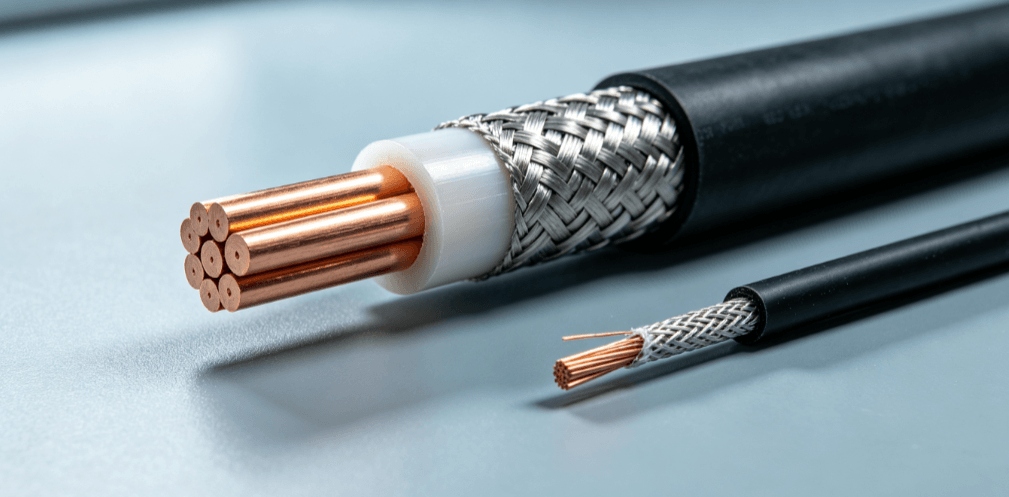
Defining the Anatomy: What is a Coaxial Cable?
A coaxial cable is defined by its physical geometry. It consists of two conductors that share a common longitudinal axis. The design is engineered to guide electromagnetic waves while confining them within the cable structure, minimizing radiation losses.
The standard construction of a coaxial cable involves four distinct layers:
- Center Conductor: Usually solid or stranded copper, or copper-clad steel, which carries the signal.
- Dielectric Insulator: A layer of polyethylene (PE), PTFE (Teflon), or foam that maintains the spacing between the inner and outer conductors.
- Outer Metallic Shield: A layer of braided wire, foil, or both, which protects the signal from external electromagnetic interference (EMI).
- Jacket: The outermost plastic layer (PVC or LSZH) that provides environmental protection against moisture, abrasion, and chemicals.
In technical terms, all RF cables used for high-frequency transmission are coaxial in design. However, not every coaxial cable is optimized for the radio frequency spectrum.
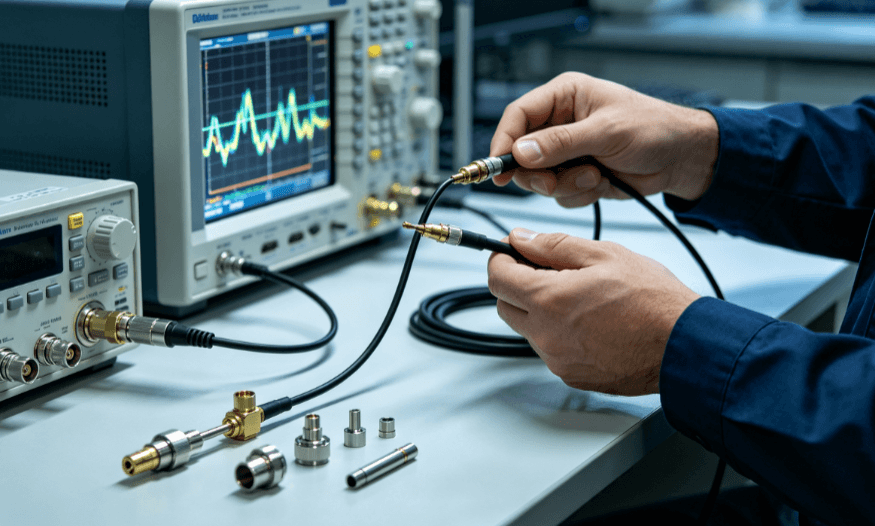
The Role of RF (Radio Frequency) in Cable Design
Radio Frequency (RF) refers to the oscillation rate of electromagnetic radiation in the range of 3 kHz to 300 GHz. When we speak of an "RF cable," we are specifically referring to a coaxial cable that has been tuned to transmit high-frequency signals with minimal "insertion loss" and "return loss."
In RF applications, the cable acts as a transmission line. At high frequencies, the wavelength of the signal becomes comparable to the physical length of the cable. This requires the cable to have a very specific "characteristic impedance." If the impedance of the cable does not match the impedance of the source (transmitter) and the load (antenna/receiver), signal reflections occur. These reflections are measured as VSWR (Voltage Standing Wave Ratio).
RF Cable vs Coaxial Cable: The Technical Comparison
While the physical structure might look identical to the naked eye, the performance specifications distinguish a general-purpose coaxial cable from a precision RF assembly.
| Feature |
General Coaxial Cable |
RF Coaxial Cable |
| Primary Use |
Baseband video, low-frequency data |
Wireless comms, Radar, Satellite, Medical |
| Impedance |
Typically 75 Ohm (Video/CATV) |
Typically 50 Ohm (Data/RF) or 75 Ohm |
| Frequency Range |
Usually < 1 GHz |
Up to 40 GHz (and beyond) |
| Shielding Logic |
Focus on RFI/EMI for clear images |
Focus on Phase stability and Low Loss |
| Typical Standards |
RG-6, RG-59 |
RG-174, RG-400, LMR-series |
The 50 Ohm vs. 75 Ohm Distinction
The most significant practical difference often lies in impedance.
- 50 Ohm Coaxial Cables: These are the industry standard for RF power handling and data transmission. Most wireless transmitters, WiFi routers, and cellular base stations utilize 50 Ohm systems because they provide a balance between power handling and low attenuation.
- 75 Ohm Coaxial Cables: These are primarily used for video signals and cable television (CATV). 75 Ohm cables are optimized for low signal loss over long distances, making them ideal for high-definition video where power handling is not the primary concern.
Key Performance Indicators in RF Interconnects
When evaluating cables for high-frequency projects, engineers must look beyond the "coaxial" label and analyze specific RF metrics.
1. Attenuation (Signal Loss)
Attenuation is the loss of signal strength as it travels through the cable, measured in decibels (dB) per 100 feet or meters. RF cables are engineered with high-grade dielectrics like expanded PTFE to minimize these losses at higher frequencies.
2. Shielding Effectiveness
For RF environments, shielding is not just about blocking noise; it is about preventing "signal leakage." In high-density environments like data centers or aerospace systems, a cable with a double-shield (braid + foil) is required to ensure signal isolation.
3. Velocity of Propagation (VoP)
VoP describes how fast a signal travels through the cable relative to the speed of light in a vacuum. High-performance RF cables often have a VoP between 80% and 85%, which is vital for time-sensitive applications like GPS or phase-matched antenna arrays.
Material Selection and Manufacturing Realities
The choice between a standard coaxial cable and a high-performance RF assembly often comes down to the operating environment. In industrial manufacturing, we categorize these choices based on mechanical constraints:
- Flexible Cables: Use stranded centers and braided shields for routing within tight enclosures.
- Semi-Rigid Cables: Use solid copper outer tubes. These offer the best shielding and lowest loss for microwave frequencies but cannot be bent once formed.
- Low-Loss LMR Series: These are designed to replace older RG-style cables, offering better shielding and lower attenuation through the use of closed-cell foam dielectrics.
Manufacturers like Soar Cable specialize in the precision assembly of these components. In high-frequency RF systems, the "weakest link" is often the interface where the cable meets the connector (such as SMA, N-type, or TNC). A cable may be "coaxial" by design, but unless the assembly is tested for VSWR and insertion loss across its intended frequency band, it may fail in a real-world RF application.
Why Context Matters for Procurement
For a B2B buyer or project manager, specifying "coaxial cable" on a purchase order is often insufficient. If the application involves 4G/5G telecommunications, industrial IoT, or laboratory testing, you must specify the RF parameters.
A "coaxial" cable designed for a security camera (75 Ohm RG-59) will cause significant signal reflection and potential hardware damage if used in a 50 Ohm RF radio system. Conversely, using a high-precision RF cable for a simple analog video feed is an unnecessary expenditure that provides no functional benefit.
FAQ: RF and Coaxial Cable Clarifications
Q1: Can I use a 75 Ohm coaxial cable for my WiFi antenna?
No. Most WiFi equipment is designed for 50 Ohm impedance. Using a 75 Ohm cable will cause an impedance mismatch, leading to high VSWR, reduced range, and potential damage to the transmitter’s power amplifier.
Q2: What does "RG" stand for in cable names?
RG stands for "Radio Guide," an old military designation. While the military standards (like MIL-DTL-17) are still used for quality benchmarks, "RG" is now used more as a generic descriptor for specific cable dimensions and constructions (e.g., RG-58, RG-174).
Q3: Are all RF cables shielded?
Yes. By definition, a coaxial structure includes an outer conductor that acts as a shield. The quality and type of shielding (single braid, double braid, or foil) vary depending on the frequency and environment.
Q4: How do I know if I need a "Low Loss" RF cable?
If your cable run is longer than 20 feet or if you are working with frequencies above 2.4 GHz, you should evaluate low-loss options. At high frequencies, standard RG-series cables can lose over 50% of the signal power within a very short distance.
Reference Sources
- IEEE Xplore: Technical papers on "Transmission Line Theory and Coaxial Design." ieee.org
- MIL-DTL-17: The United States military standard for coaxial cable requirements. quicksearch.dla.mil
- Pasternack RF Calculator: Industry-standard tool for calculating attenuation and VSWR. pasternack.com
- SGS / UL Documentation: Standards for cable jacket flame ratings (CMP, CMR, LSZH). sgs.com


